 tvowmedia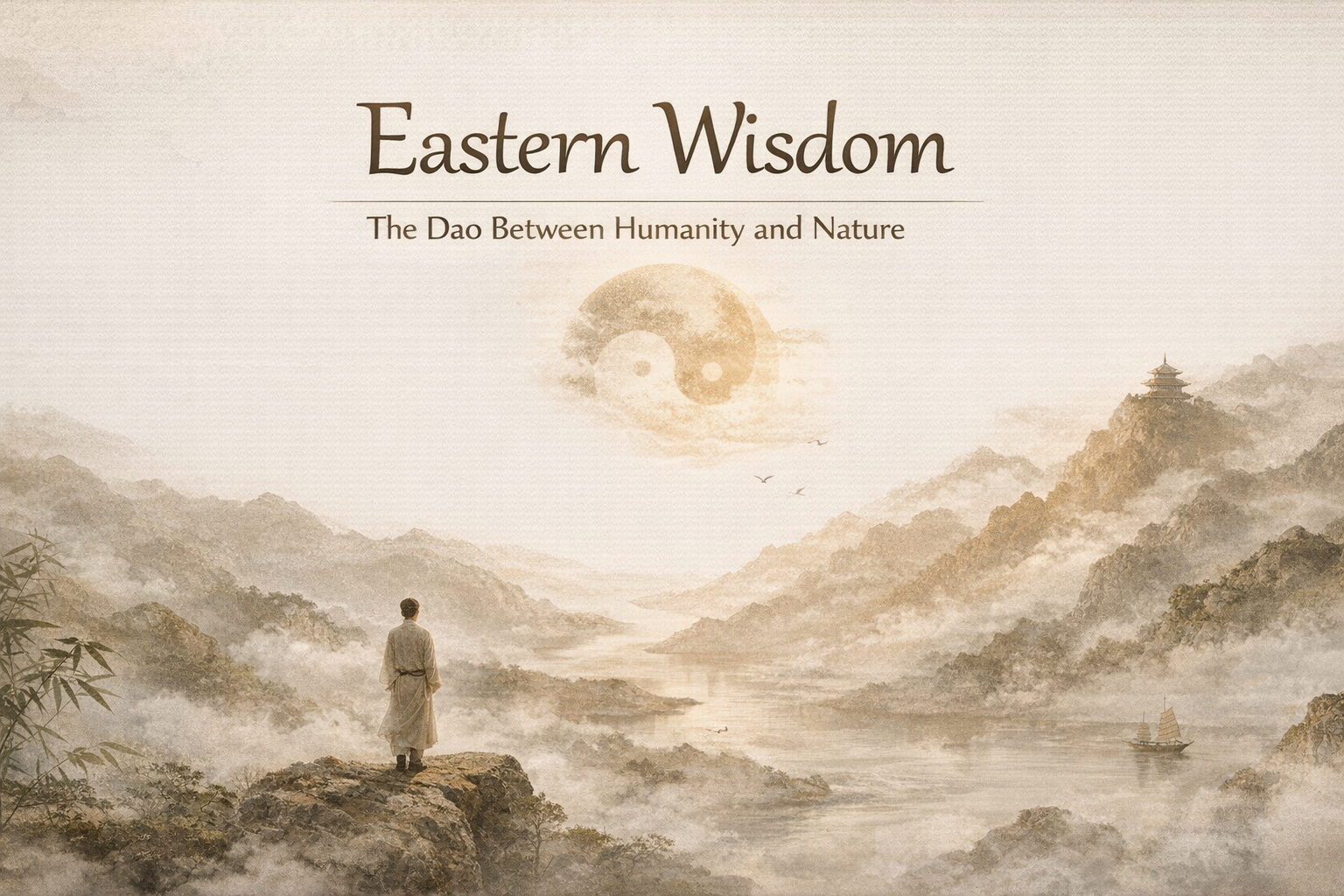
—— Eastern wisdom is not a mysterious force, but a way of looking at the world.
I've always wanted to create a column, a series of articles about "Eastern wisdom." Now, I'm officially naming this column—Eastern Wisdom。

I've been pondering a question: Where exactly do the cultural differences between East and West lie? Or rather, what are their fundamental differences?
From an Eastern perspective, Westerners often perceive Eastern culture and civilization as "mysterious." They are fascinated by Eastern mythology and have developed a strong curiosity about this "mystery."
But in my view, so-called "Eastern wisdom" is first and foremost a culture.
Many Westerners interpret this as "Chinese mythology," even believing that Chinese people are "believers in gods." However, "belief in gods" is actually more of a part of Western culture. In Western religious systems, people often develop their faith around a "god" and live and act according to that god's will.
China, with its five-thousand-year-old cultural history, has never had a single, unchanging god from beginning to end.
Different eras have different images of "gods," but these "gods" are constantly changing and are products of their time. It is precisely because of this that, generally speaking, Chinese people do not "believe in gods" in their daily lives.
So, what do Chinese people believe in?
In fact, Chinese people are closer to the concept of "Tao" (the Way).
The concept of "Tao" manifests itself in many concrete ways in real life. For example, we often say "Tao follows nature," meaning that the true "original teaching" in Chinese culture is "Tao." Tao is about entering with sincerity, upholding it with silence, and applying it with gentleness.
Many people confuse "Taoism" with "Tao," but in reality, Taoism is just one manifestation of "Tao," and only a part of "Tao" in Chinese culture. The true "Tao" speaks of the relationship between humanity and nature.
Dao, Dharma, Instrument, Qi, Heavenly Dao
For example, as we often say:
Dao (道) – the fundamental law
“The "Tao" is the root of everything, the law governing the universe. It is not a concrete thing, nor a "god," but an invisible yet ever-present order. For example, the changing of the seasons, birth, aging, sickness, and death, and the cycle of all things—these underlying "laws" are the "Tao."
This can be understood as the "fundamental reason" for why the world works the way it does.
Law (Fǎ) – a method of conforming to rules
“"Law" refers to the way people align themselves with "Tao." Once you understand "Tao," you must find suitable methods to follow it. For example, acting in accordance with the natural order, not going against nature, and acting with discretion.
This can be understood as: how people should interact with the world in a proper way.
Qi (器) – specific tools and forms
“"Qi" refers to the specific form that carries "Dao" and "Fa". It can be a tool, such as Feng Shui, Bagua, or symbols; it can also be a system, rules, framework, or even language and rituals.
This can be understood as: turning abstract concepts into operable tools.
Qi (气) – flowing energy
“"Qi" is a flow of energy that connects humans with nature. In Eastern culture, people possess qi, spaces possess qi, and the environment possesses qi. It is constantly flowing and changing, influencing people's state. For example, emotions affect the body, the environment affects fortune, and there is also an "qi field" between people.
It can be understood as an invisible but perceptible state of energy. The "destiny" we often talk about is, to some extent, related to the way of heaven and fate.
The Way of Heaven (Tiān Dào) – a higher-level law
“"The Way of Heaven" is a greater natural law that transcends the individual. It refers to the overall order of the universe, a law that is independent of individual will. Examples include the principle that prosperity inevitably leads to decline, the cycle of cause and effect, and the law of balance.
This can be understood as: the fundamental laws that humans cannot change, but must respect.
Therefore, it can be simply stated as follows:
The Tao is the law;
Law is a method;
"器" means tool;
Qi is energy;
The Way of Heaven is a higher level of order.
These concepts don't just exist in books; they permeate the daily language and lives of Chinese people. Often, we don't even realize that we are using "Tao" (the Way).
For example, we might say:
“"Ants don't urinate; they each have their own way of doing things."”
“"Which gang are you from?"”
“This approach is unethical.”
These words sound very down-to-earth and relatable, but they all express the same thing.
In these contexts, "Tao" is no longer an abstract philosophical term, but a way of judging that has been integrated into life. It can be a path for doing things, a method of dealing with the world, and an intuitive judgment of "right and wrong" and "harmony and incompatibility".
Sometimes, we don't consciously try to explain it, but we subconsciously feel that something is "right" or "wrong".
Looking deeper, the "Tao" here is actually a kind of "natural law," a "law" that conforms to the operation of all things. It can even be said that it carries a hint of "destiny"—not something imposed on you, but rather a "how it should be" that you will suddenly understand or vaguely feel at a certain moment.
This is why "Tao" has never been a lofty concept in Chinese life, but rather something that is constantly used and experienced.
“Why is the "Tao" so important?
In Chinese culture, the importance of "Tao" is actually much deeper than we realize in our daily lives.
For example, the *Tao Te Ching* is something many people have heard of, and quite a few have tried to read, but few can truly understand it. Its language seems simple, yet it contains an extremely profound system of thought.
Even so, the *Tao Te Ching* cannot fully explain the entirety of the "Tao." This is because the "Tao" itself cannot be clearly explained in a single book. It is more like a law existing between heaven and earth, something that needs to be experienced rather than defined.
In real life, Chinese people have always been using the concept of "Tao." We respect it, revere it, and unconsciously make judgments and choices based on it. However, most of the time, this use is subconscious and habitual.
We constantly apply the Tao in our lives, but we rarely stop to seriously consider: what exactly is the Tao we are talking about?
“Different ways of expressing "Tao"
“There are actually many ways to express the concept of "Tao".
For example, Taoism attempts to regulate the relationship between humans and nature, and to influence the "energy" and "magnetic field" between humans and the environment through talismans, language, and rituals, thereby achieving a state of "conforming to the will of Heaven".
For example, the I Ching and the Eight Trigrams, which are often considered mysterious systems, are essentially talking about the same thing—"Tao".
They use systems such as Heavenly Stems and Earthly Branches, and the Five Elements to describe the relationship between a person and the universe at the moment of birth; and how this relationship changes over time, thus affecting the individual.
Ultimately, it all points to the same core issue:
The relationship between humans and nature.
Why is it misunderstood as "superstition"?
So why are these contents perceived as "superstition" by many people?
One very important reason is that the relationship between humanity and nature is inherently extremely complex and profound. Some aspects cannot be fully explained by modern science; and some experiences are difficult to express in standardized language.
In the process of dissemination, if only one fragment is grasped and amplified, it is easy to deviate from the original logic, evolve into so-called "pseudoscience," or even be pushed into a gray or restricted field.
But at the same time, more and more people are beginning to rethink these issues.
They began to realize that there was indeed a relationship between humans and nature, and that this relationship was not as simple as it appeared on the surface.
Fate, fortune, and the changes in people
In this system, "Tao" is often associated with "fate," and "fate" is in turn associated with "fortune."
Fate is predetermined.
Fortune is a process of change after birth.
In other words, a person's life is composed of both "nature" and "nurture".
This also explains why some people think "fortune telling is inaccurate," while others think it is "very accurate."
Because some people, through their actions, habits, and choices in life, change their original trajectory; while others continue along the existing path. Different choices lead to different life paths.
In addition, there is another very practical reason why people believe in religion: religion can restrain people's behavior and inner thoughts.
When a person is kind-hearted and acts positively, the "energy" and "magnetic field" around him will also change, thus affecting the direction of his life.
There is another Chinese saying:“"The environment changes with one's mindset"”。
This means that a person's environment changes according to their inner state. Your mindset affects the "energy" and "magnetic field" around you, which in turn affects the reality you experience.
This might be called "idealism" in some theories, but in real life experience, this influence is real.
My understanding of Eastern wisdom
Therefore, in my view, although Eastern wisdom may seem profound, it is actually quite simple when summarized:
It talks about the relationship between humans and nature.
and--
People can change;
Naturally, it will also change as people change.
This, perhaps, is what I understand as "Eastern wisdom."
I also hope that through this column, I can use the simplest language to explain these originally complex contents clearly, so that more people can understand Eastern wisdom, rather than misunderstand it.
Eastern wisdom is not the answer, but a way of seeing the world.
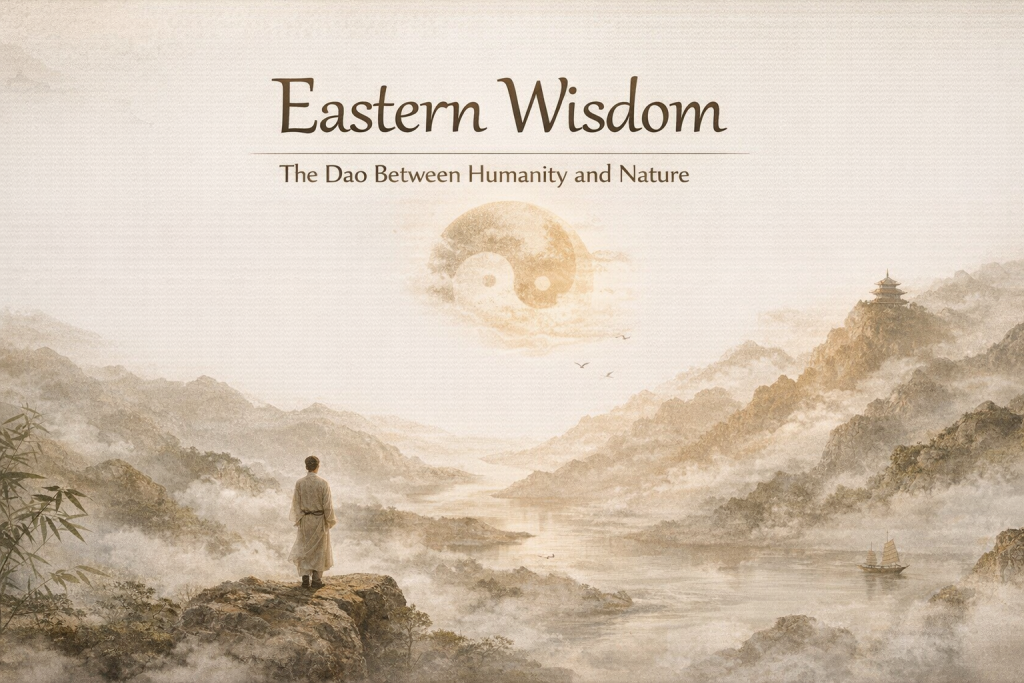
Eastern Wisdom: The “Dao” Between Humanity and Nature
Eastern wisdom is not a fixed answer, but a way of understanding the world.
For a long time, I have wanted to create a column—to write a series of reflections on what I call “Eastern wisdom.”
Now, I have finally given it a name: Eastern Wisdom.
I have often found myself thinking about one question:
What is the fundamental difference between Eastern and Western cultures?
From an Eastern perspective, many people in the West see Eastern culture as something mysterious.
They are fascinated by its myths, symbols, and traditions, often drawn to what feels like an unexplained depth.
But in my view, this sense of mystery is often a misunderstanding.
Because Eastern wisdom, at its core, is not about mystery.
It's about culture.
Many people interpret it as “Chinese mythology,” or assume that Chinese people “believe in gods.”
But in fact, the idea of “believing in a single God” belongs more to Western traditions, where faith is often centered around a supreme being whose will guides human behavior.
China, however, with its five thousand years of history, has never had one single, unchanging, absolute god.
Different eras have had different symbolic figures, different narratives, different beliefs.
They evolved with time, shaped by history.
And because of this, Chinese people, in their everyday lives, are not really “believing in gods.”
So what do they believe in?
They believe in something else.
The Dao
Chinese people are, in many ways, closer to believing in something called the Dao.
Dao is not a god.
It is not something you can see or name directly.
It is a principle, a pattern, a way in which the world unfolds.
When we say “following the Dao,” we are not talking about worship.
We are talking about understanding how things naturally work—and aligning with it.
This is why, in Chinese culture, people often say:
“"Dao follows nature."”
One enters the Way with sincerity,
They abide in it through silence.,
and expresses it through gentleness.
And this is also why what many call “Daoism” is only one expression of something much larger.
The Dao itself is not limited to religion—it is a way of understanding the relationship between human beings and the natural world.
Dao, Fa, Qi, and Tian Dao
Within this cultural framework, several ideas are often used together:
Dao — the underlying principle of the universe
Fa — the methods of following that principle
Qi — the flow of energy
Tian Dao — the greater order beyond human control
In simple terms:
The Dao is the law of how things are.
Fa is how we act in accordance with it.
Qi is the invisible energy that connects everything.
Tian Dao is the larger order we must respect, whether we understand it or not.
The Dao in Everyday Life
The Dao is not just a philosophical concept.
It lives in everyday language.
People say things like:
“"Everyone has their own way."”
“"Which path do you belong to?"”
“"That doesn't follow the Dao."”
These phrases may sound casual, even simple, but they carry a deeper meaning.
The Dao, in these moments, becomes a kind of intuitive judgment.
A way of sensing whether something feels right—or not.
It is not something we calculate.
It is something we recognize.
At a deeper level, it reflects what we might call “natural order,” or even “the way things are meant to be.”
Not imposed, not forced—but quietly understood.
Why It Is Often Misunderstood
When expressed through forms like rituals, symbols, or systems such as the I Ching and the Eight Trigrams, these ideas are often labeled as “mystical” or even “superstitious.”
But the issue is not the ideas themselves.
It is how they are understood.
The relationship between humans and nature is complex.
Some aspects are still beyond what modern science can fully explain.
When only fragments are taken out of context and exaggerated, they can easily be misinterpreted as superstition or pseudoscience.
And yet, at the same time, more people are beginning to reconsider these ideas.
They are starting to sense that there is indeed a deeper relationship between human beings and the world around them.
Fate and Change
Within this framework, the Dao is often connected to the idea of fate.
In Chinese thought:
Fate (Ming) refers to what is given at birth
Fortune (Yun) refers to how things change over time
Life is shaped by both.
This helps explain why some people feel that predictions are accurate, while others do not.
Because some people change—through choices, habits, and actions.
And others follow a path without deviation.
Different choices lead to different outcomes.
The Power of the Mind
There is another important idea:
Religion, in many cases, exists not only as belief, but as a way to guide human behavior.
When a person acts with kindness and integrity, their “energy” changes.
Their environment responds differently.
In Chinese culture, there is a phrase:
“The environment shifts with the heart.”
It means that your inner state shapes your external world.
Your mindset affects your energy, your relationships, and ultimately your life experience.
Some may call this idealism.
But in lived experience, it is very real.
What Eastern Wisdom Really Is
So in the end, what is Eastern wisdom?
It may seem complex, but it can be distilled into something simple:
It is about the relationship between human beings and nature.
And more importantly:
Human beings can change.
And as we change, the world around us changes with us.
Why This Column Exists
This is what I understand as Eastern wisdom.
And through this column, I hope to express these ideas in the simplest and most accessible way possible.
Not to make them more mysterious,
but to make them more understandable.
So that more people can begin to see Eastern wisdom not as something distant or obscure—
but as a way of understanding life itself.
Eastern wisdom is not a fixed answer, but a way of understanding the world.