Bilingual reading instructions: The Chinese text is the original expression, and the English translation is placed at the end of the text.
Bilingual Note: Chinese first, English follows below.
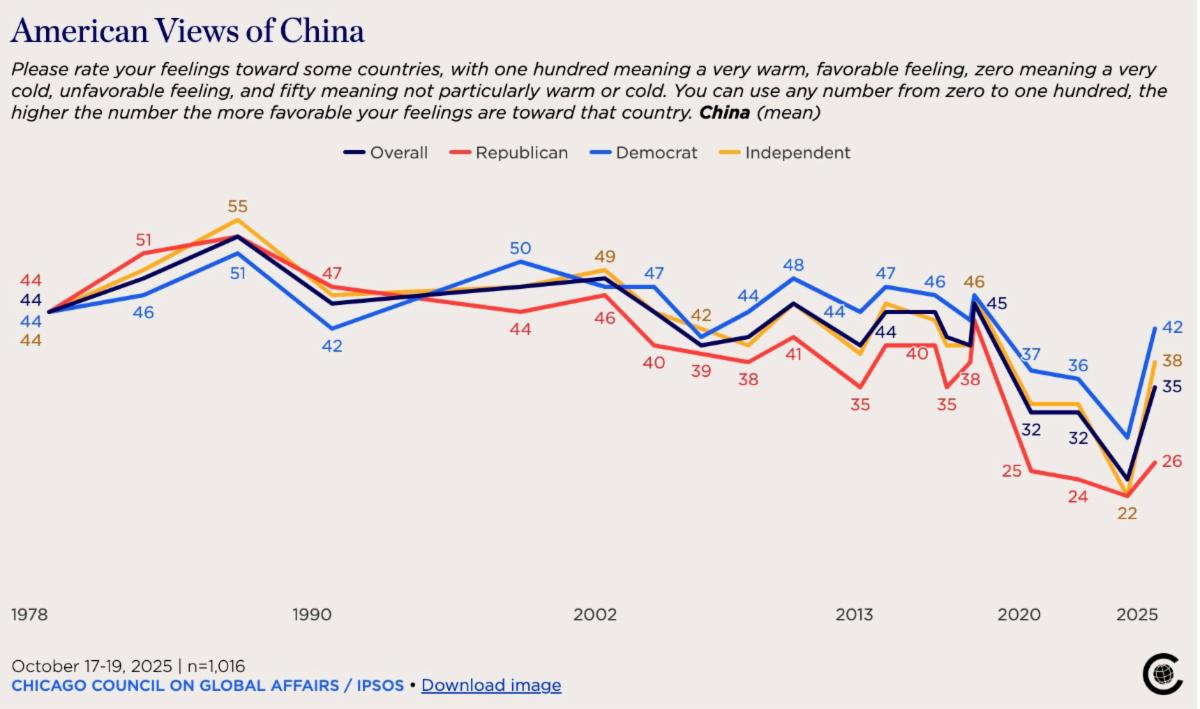
A Chicago Council survey shows 53% of Americans now favor cooperation with China, the first majority since 2019, driven by Democrats' 19-point shift, though deep partisan divides persist on trade and security issues.A survey report released on October 28 by the Chicago Council on Global Affairs shows a significant shift in American public attitudes toward China. Based on a survey of over 2,000 American adults conducted between July and October, the report found that 531% of respondents supported “friendly cooperation and engagement” with China, marking the first time since 2019 that more than half of Americans have favored a cooperative stance. Meanwhile, the proportion viewing China as a “key threat” dropped from 581% in 2023 to 501%, while favorability toward China rebounded from a record low of 241% in 2024 to 351%. Despite the increased willingness to cooperate, the US stance remains firm in key areas: 621% of respondents considered avoiding military conflict their top priority, 581% emphasized maintaining technological leadership, and 821% opposed China establishing a sphere of influence in Asia. This shift was primarily driven by Democratic voters. A staggering 661% of Democrats support cooperation (a 19-point surge from 2024), while only 331% of Republicans hold the same view, creating a 33-point partisan divide. This is the largest split on China since the survey was first included in 2006. On trade policy, 541% of Americans oppose simply raising tariffs on China, but 661% of bipartisan respondents support a trade-off where tariffs are lowered in exchange for China reducing its trade surplus. Report author Craig Kafura argues that the inflationary pressures and rising cost of living resulting from the ongoing tariff war have prompted the public to reassess the costs of confrontation. The report concludes that this shift in public opinion is "tactical rather than strategic," reflecting a desire for "managed competition" rather than a zero-sum game.

 tvowmedia