
 tvowmedia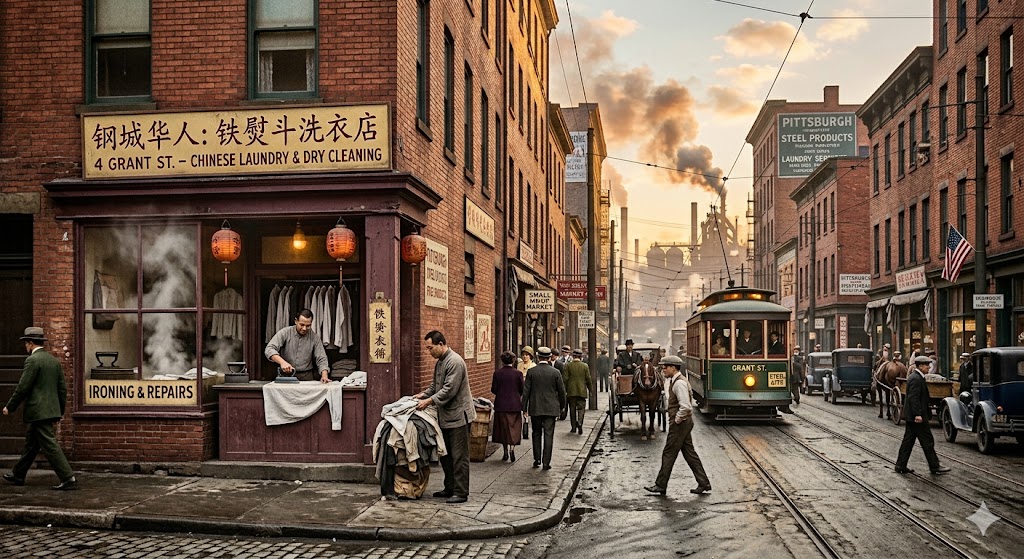
——匹兹堡华人经济的兴起与族裔壁垒下的生存
在十九世纪后期美国工业化的宏大叙事中,匹兹堡作为“世界钢铁之都”的崛起占据着重要位置。城市上空常年弥漫着煤烟,高炉昼夜运转,钢铁工业推动着这座城市迅速扩张。
然而,在这片由钢铁与机器主导的工业景观中,一个规模极小却极具韧性的移民群体,正以另一种方式,寻找自己的生存空间。
1875年,匹兹堡市中心 Grant Street(格兰特街)出现了当地最早有记录的华人洗衣店。据历史记载,这家洗衣店由一名华人移民开设,成为匹兹堡华人商业活动的最早实例之一。
这看似微不足道的一家小店,却标志着一个重要历史过程的开始。
在当时的匹兹堡,大多数钢铁厂和大型工业企业并不愿意雇佣华工。在这种排斥环境下,华人移民逐渐转向一些资本门槛较低、同时又能依靠自身劳动维持生计的行业,例如洗衣业与小型餐饮业。
由此,一个典型的“族裔经济”(Ethnic Economy)开始形成。
这些洗衣店不仅是谋生的方式,也成为华人移民在城市中建立社会网络的重要节点。围绕着这些小型商业,华人社区逐渐出现,并在城市空间中形成最早的聚集区域。
从某种意义上说,格兰特街上的那只铁熨斗,正是匹兹堡华人经济史的起点。
工业高峰与生存空间的形成
华人移民进入匹兹堡的历史背景十分复杂。
19世纪中期,美国西部曾吸引大量中国劳工。1849年的加利福尼亚淘金热,使成千上万的华人来到太平洋沿岸;而在1860年代,他们又成为跨大陆铁路建设的重要劳动力。然而,随着金矿资源逐渐枯竭,以及1869年跨大陆铁路的建成,许多华工原有的工作机会开始减少。
与此同时,西部地区日益高涨的排华情绪、种族歧视以及针对华人的暴力事件,也迫使不少华工离开原来的聚居地,寻找新的生计。
在这种背景下,一部分华工开始向美国东部和中西部的工业城市流动。
匹兹堡正是在这一时期迅速崛起的工业中心。钢铁厂、煤矿以及密集的铁路网络,使这座城市成为美国最重要的工业城市之一。
然而,当华工抵达这里时,他们很快发现,这座钢铁之城的主要工业部门并不向他们开放。钢铁厂和煤矿的工作岗位大多被欧洲移民工人占据,而华人则被排除在这些行业之外。
在这样的限制之下,华人移民不得不寻找新的生存方式,并逐渐进入一些被主流劳动力市场忽视的行业——例如洗衣业、小型餐馆以及其他服务性行业。
正是在这样的历史条件下,匹兹堡的华人族裔经济(Ethnic Economy)开始逐渐形成。
贝弗福尔斯实验及其历史影响
在匹兹堡出现稳定的华人社区之前,宾夕法尼亚西部曾发生过一次颇具争议的“华工实验”。
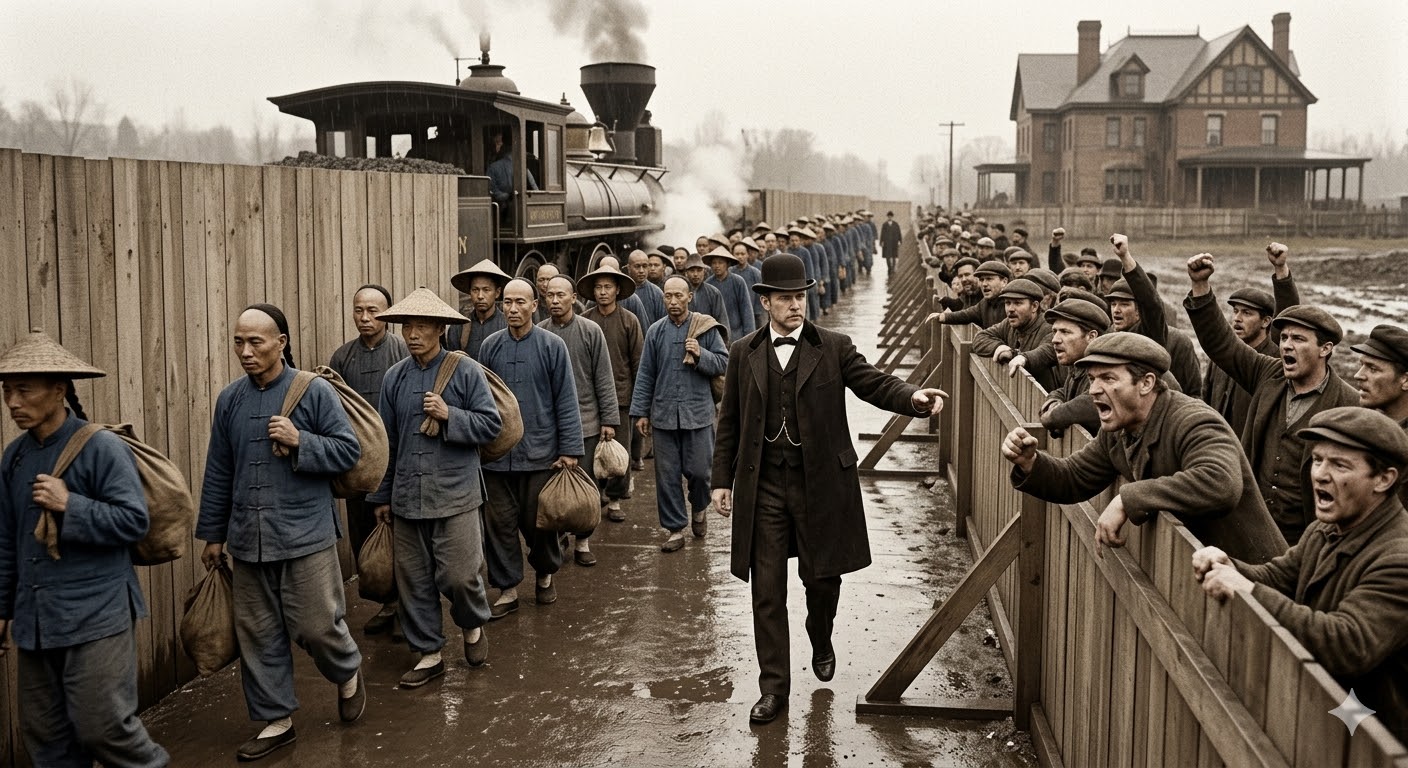
1872年,位于匹兹堡北部约三十英里的 Beaver Falls Cutlery Company(贝弗福尔斯餐具公司),为了打破白人工会发动的罢工,从路易斯安那州和加利福尼亚州招募了约三百名华工。这些劳工被安排进入工厂生产,以替代参与罢工的白人工匠。
在生产过程中,这些华工表现出相当高的效率。根据当时的记录,他们在学习制造技术和完成生产任务方面的表现,甚至在某些环节上超过了来自英国和爱尔兰的工匠。
然而,这一“华工实验”很快激起了强烈的社会反弹。
许多白人工人将华工视为破坏罢工的“工贼”,并认为资本家正在利用廉价劳动力压低工资。当地社会舆论也逐渐将这一事件与当时流行的“黄祸”恐慌联系在一起,使得华工问题迅速政治化。
最终,这次劳动力实验并未长期持续。随着经济环境变化以及社会冲突加剧,华工逐渐离开贝弗福尔斯。到1880年前后,这一短暂存在的华工社区已经基本消失。
但这场实验却在当地工业界留下了深刻影响。
匹兹堡的钢铁企业和工会从中吸取了经验教训。他们认为雇佣华工可能引发更严重的劳资冲突和社会紧张,因此在后来的工业扩张中,更倾向于从东欧和南欧招募移民劳工,而不是雇佣华人。
这种结构性的排斥,使华人移民难以进入钢铁工业体系。
在这种背景下,许多华人不得不转向白人工人不愿从事或逐渐退出的行业——尤其是手工洗衣业。正是这种经济选择,最终推动了匹兹堡早期华人商业社区的形成。
洗衣业作为“生存空间”的形成
华人移民之所以大量进入洗衣业,并不是因为他们天生擅长这一行业,而是在高度歧视的社会环境下形成的一种现实选择。
在19世纪的美国社会,洗衣工作通常被视为“妇女的劳动”,被认为缺乏男子气概,因此社会地位较低。正因为如此,许多白人男性并不愿意从事这一行业。
对于被排除在工业体系之外的华人移民来说,这种被忽视的行业反而提供了一种重要的生存机会。
开设一家手工洗衣店所需的资本相对有限。只需租下一间小店铺,配备简单的洗涤设备和熨烫工具,便可以开始经营。此外,这类生意对英语能力的要求也不高,通常只需要掌握基本的接单和取衣交流即可。
更重要的是,经营洗衣店意味着华人可以成为自雇劳动者,而不是受雇于排斥他们的白人老板。这在一定程度上减少了他们在工厂或矿井中遭受歧视和剥削的风险。
与此同时,在19世纪末的大多数美国城市中,机械化洗衣业尚未完全普及。许多社区仍然需要依赖手工洗衣服务,这为华人洗衣店提供了稳定的市场。
在这样的社会与经济条件下,洗衣业逐渐成为华人移民的重要经济基础。
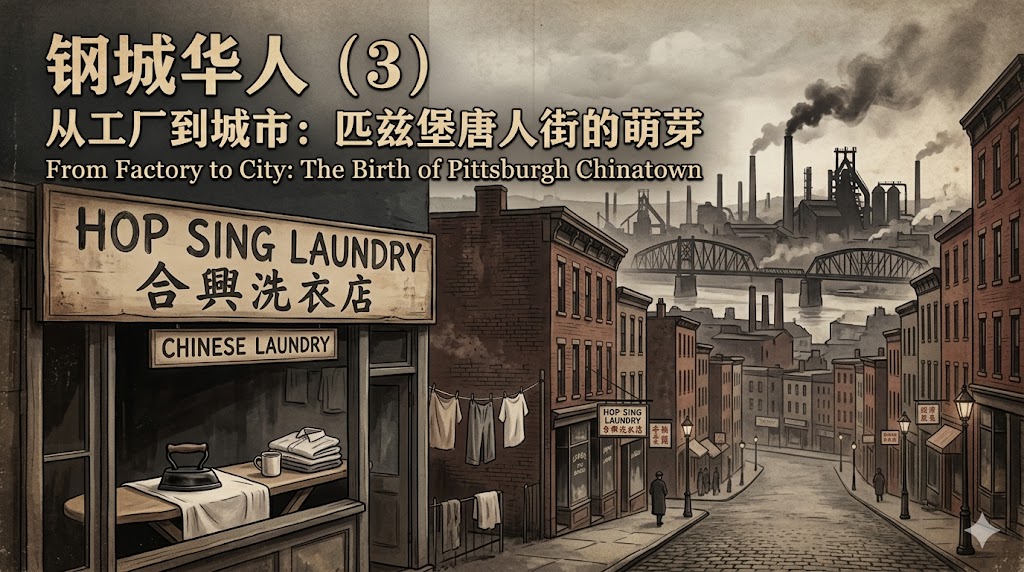
到1888年,匹兹堡的华人洗衣店数量已经达到59家。进入20世纪后,这一行业继续扩张,并在1930年代达到约129家的高峰。
这些洗衣店分布在城市的各个街区。从市中心到住宅区的主要街道旁,都可以看到它们的身影。小小的店铺里常常挂满晾晒的衣物,蒸汽在窗户间弥漫。
在钢铁厂烟囱与煤烟弥漫的工业城市中,这些不起眼的洗衣店,逐渐成为匹兹堡城市生活景观的一部分。
格兰特街的起点与 Cherry Way 的城市空间
1875年,当一位名叫李洪的华人移民在 Sixth Avenue 与 Smithfield Street 附近挂出“来自加州的华人洗衣店”招牌时,他实际上在匹兹堡市中心建立了这座城市最早的华人商业据点之一。
这一家小小的洗衣店,位于格兰特街不远处的商业街区。对当时的匹兹堡来说,它或许只是城市日常商业景观中的一个不起眼的店铺;但对华人移民而言,这却意味着一种新的立足方式。
在工业城市高度排斥华人进入钢铁厂和矿井的情况下,这样的小型商业成为他们在城市中生存的重要途径。
随着时间推移,类似的洗衣店逐渐在 Grant Street、Cherry Way 以及附近街区出现。围绕这些店铺,一个规模不大却逐渐稳定的华人商业网络开始形成。
因此,格兰特街不仅是一个简单的地理坐标,也成为匹兹堡早期华人族裔经济的象征性空间。
在这些狭窄街巷之间,小小的洗衣店、餐馆和杂货铺,逐渐构成了匹兹堡最早的华人社区雏形。
铁熨斗与煤炉的日夜
在19世纪末的匹兹堡市中心小巷,特别是 Cherry Way 附近,华人洗衣店的生活异常艰辛。
这些小小的店铺不仅是商业空间,也是工人日夜劳作的生活场所。店内的“物质文化”,几乎完全由高强度体力劳动和简陋的工作环境所构成。
其中最常见的工具,是沉重的铸铁熨斗。
华人洗衣工使用的熨斗通常重达六磅(约三公斤)。这些铁熨斗需要不断放在火炉上加热,然后再用于熨烫衣物。为了保持熨烫的温度和效率,工人必须反复更换熨斗。长时间的操作不仅需要强大的腕力,也需要在高温环境中持续工作。
另一件几乎每家洗衣店都必备的设备,是煤炉(Coal Stove)。
匹兹堡作为重要的煤炭产区,燃料价格相对低廉,因此洗衣店通常使用煤炉来加热熨斗。煤炉同时也承担着取暖和煮食的功能。然而,煤炭燃烧产生的烟尘和热量,使店内常年处于闷热和烟雾弥漫的环境之中。
在这样的空间里,洗衣、熨烫、做饭与休息往往同时进行。
在 Cherry Way 这样狭窄的小巷中,这些洗衣店一家接一家排列。虽然在城市地图上这里只是一条不起眼的后巷,但在19世纪末,这里却挂满了红底金字的华人招牌。
这些招牌不仅标示着一家家洗衣店的存在,也象征着华人移民在这座工业城市中的努力与坚持。
在钢铁厂烟囱与煤烟弥漫的城市景观之外,这些小小的店铺构成了匹兹堡另一种隐秘而坚韧的生活世界。
工作流程与居住空间的重合
早期的华人洗衣店大多采用一种“店住合一”的生活方式。
在匹兹堡市中心那些狭小的店铺里,商业空间与生活空间几乎没有明显的界限。店铺前部通常是接待顾客和收取衣物的柜台,而后部则被划分为洗涤区、熨烫区和简单的储物空间。至于休息的地方,往往只是角落里摆放的一张窄床或几块木板搭成的睡铺。
在这样的环境中,工作与生活几乎融为一体。
华人洗衣工的一天通常从清晨开始,一直持续到深夜甚至凌晨。漫长的劳动时间,使洗衣店始终处于忙碌状态。
最辛苦的工序是浸泡与刷洗。工人们需要把衣物放入装满肥皂水和漂白粉的大木盆中,用双手反复揉搓和刷洗。长时间接触化学洗涤剂,使许多人的双手变得粗糙甚至开裂。
完成清洗之后,衣物需要手工拧干,然后挂在店内横跨的铁线上晾晒。由于洗衣店空间狭小,湿衣物往往挂满整个房间,使空气长期处于潮湿状态。
接下来是熨烫。沉重的铁熨斗被不断放在煤炉上加热,再迅速拿起用于压平衣物。为了保持温度,工人们需要不断轮换熨斗,这一过程既费力又具有一定危险性。
当衣物整理完毕后,洗衣店会在每件衣物上系上红色的订单纸签。这种小小的纸签记录着顾客姓名或编号,也成为华人与当地居民之间最直接的商业联系。
在这些狭窄而忙碌的空间里,洗衣、熨烫、吃饭与睡眠交织在一起。洗衣店不仅是一种谋生的行业,也成为早期华人移民在匹兹堡城市生活的基本单位。
社区雏形:洗衣店背后的社会结构
在19世纪末的匹兹堡,洗衣店不仅仅是一门谋生的生意。
对于早期的华人移民来说,这些小小的店铺往往也是他们在城市中的第一个落脚点。许多新来到匹兹堡的华工,往往会先到同乡经营的洗衣店暂住几日,在这里打听工作机会、寻找住处,或者了解城市的基本情况。
因此,一家洗衣店的意义远远超过了普通商铺。它既是工作场所,也是信息交流的节点。
在当时的美国社会,华人移民几乎没有政治权利。尤其是在1882年《排华法案》(Chinese Exclusion Act)颁布之后,华人不仅难以获得公民身份,也很难通过正式渠道获得社会支持。
在这种制度性的排斥之下,华人社区只能依靠彼此之间的互助来维持生存。
洗衣店正是在这样的背景下,逐渐承担起更多社会功能。它们不仅提供工作机会,还成为同乡之间交换消息、介绍工作的地方。有人需要寻找新的店铺伙伴,有人需要向远方的亲人寄信,也有人刚刚抵达城市,正在寻找一个可以暂时安身的角落。
久而久之,这些分布在城市各处的洗衣店,便形成了一种松散却稳定的社会网络。
正是通过这种网络,匹兹堡最早的华人社区逐渐出现雏形。
Next episode preview
在这些分散于匹兹堡街区的洗衣店背后,
一种看不见的联系,正在悄然形成。
它不依赖制度,
也不写在法律之中,
却真实地支撑着华人移民的生存与流动。
从一间店,到一张网,
从个体谋生,到群体互助,
一个早期华人社区的结构,正在慢慢显现。
Steel City Chinese (4)
The Cast-Iron Flatiron on Grant Street: The Rise of Pittsburgh Chinese Economy and Survival Under Ethnic Barriers
In the grand narrative of late nineteenth-century American industrialization, Pittsburgh’s rise as the “Steel Capital of the World” occupied a central place. Coal smoke hung over the city year-round, blast furnaces ran day and night, and the steel industry drove the city’s rapid expansion.
Yet within this industrial landscape dominated by steel and machinery, a very small but remarkably resilient immigrant group was searching for its own way to survive.
In 1875, the earliest recorded Chinese laundry in Pittsburgh appeared on Grant Street in downtown Pittsburgh. According to historical records, this laundry was opened by a Chinese immigrant and became one of the earliest examples of Chinese commercial activity in the city.
This seemingly insignificant little shop marked the beginning of an important historical process.
At that time in Pittsburgh, most steel mills and large industrial enterprises were unwilling to hire Chinese workers. In such an exclusionary environment, Chinese immigrants gradually turned to industries with lower barriers to entry, industries in which they could still rely on their own labor to make a living, such as laundries and small restaurants.
Out of this, a typical “ethnic economy” began to take shape.
These laundries were not only a means of livelihood, but also important nodes through which Chinese immigrants built social networks in the city. Around these small businesses, a Chinese community gradually emerged and formed the earliest clustered Chinese spaces in the city.
In a sense, the cast-iron flatiron on Grant Street was the starting point of Pittsburgh Chinese economic history.
The Industrial Boom and the Formation of Survival Space
The historical background of Chinese immigrants entering Pittsburgh was highly complex.
In the mid-nineteenth century, the American West attracted large numbers of Chinese laborers. The California Gold Rush of 1849 brought thousands of Chinese to the Pacific Coast, and in the 1860s they became an important labor force in the construction of the transcontinental railroad. Yet as gold resources were gradually depleted, and after the completion of the transcontinental railroad in 1869, many of the jobs that Chinese laborers had once depended on began to disappear.
At the same time, rising anti-Chinese sentiment, racial discrimination, and violence against Chinese people in the West forced many Chinese laborers to leave their original communities and seek new livelihoods.
Against this background, some Chinese workers began moving eastward and into the industrial cities of the Midwest.
Pittsburgh was one of the industrial centers rising rapidly in this period. Steel mills, coal mines, and dense railroad networks made it one of the most important industrial cities in the United States.
Yet when Chinese workers arrived, they quickly discovered that the city’s main industrial sectors were not open to them. Jobs in steel mills and coal mines were largely occupied by European immigrant workers, while Chinese workers were excluded from these industries.
Under such constraints, Chinese immigrants had to look for other ways to survive, gradually entering sectors overlooked by the mainstream labor market, such as laundries, small restaurants, and other service trades.
It was under these historical conditions that Pittsburgh’s Chinese ethnic economy gradually began to take shape.
The Beaver Falls Experiment and Its Historical Impact
Before a stable Chinese community appeared in Pittsburgh, western Pennsylvania had already witnessed a controversial “Chinese labor experiment.”
In 1872, the Beaver Falls Cutlery Company, located about thirty miles north of Pittsburgh, recruited about three hundred Chinese laborers from Louisiana and California in order to break a strike led by white union workers. These laborers were brought into the factory to replace the striking white craftsmen.
In production, these Chinese workers proved highly efficient. Contemporary records suggest that in learning manufacturing skills and completing production tasks, they sometimes even outperformed craftsmen from England and Ireland.
Yet this “Chinese labor experiment” quickly provoked a fierce social backlash.
Many white workers regarded the Chinese as “strikebreakers” and believed that capitalists were using cheap labor to depress wages. Local public opinion gradually linked the event to the “Yellow Peril” panic of the era, rapidly politicizing the Chinese labor question.
In the end, the labor experiment did not last long. As economic conditions changed and social conflict intensified, the Chinese workers gradually left Beaver Falls. By around 1880, this short-lived Chinese community had largely disappeared.
But the experiment left a deep impression on the regional industrial world.
Pittsburgh’s steel companies and labor organizations drew lessons from it. They came to believe that employing Chinese workers might trigger even more severe labor conflict and social tension. As a result, in later industrial expansion, they tended to recruit immigrant laborers from Eastern and Southern Europe rather than hire Chinese workers.
This structural exclusion made it difficult for Chinese immigrants to enter the steel industry.
Under these conditions, many Chinese had little choice but to turn to occupations that white workers were unwilling to do or were gradually abandoning, especially hand laundries. It was precisely this economic shift that helped drive the formation of Pittsburgh’s early Chinese commercial community.
Laundry Work as a “Space of Survival”
Chinese immigrants entered the laundry business in large numbers not because they were naturally suited to it, but because it was a practical choice shaped by a highly discriminatory social environment.
In nineteenth-century America, laundry work was typically seen as “women’s labor,” considered lacking in masculinity and therefore of low social status. For that very reason, many white men were unwilling to engage in it.
For Chinese immigrants excluded from the industrial system, this overlooked trade instead offered an important opportunity for survival.
Starting a hand laundry required relatively little capital. One only needed to rent a small storefront and equip it with simple washing and ironing tools to begin operation. In addition, the trade did not require much English, usually only enough to take orders and return clothing.
More importantly, running a laundry meant that Chinese workers could be self-employed rather than hired by white employers who discriminated against them. To some extent, this reduced their exposure to discrimination and exploitation in factories and mines.
Meanwhile, in most American cities at the end of the nineteenth century, mechanized laundry services had not yet become fully widespread. Many communities still relied on hand laundry services, which provided a stable market for Chinese laundries.
Under these social and economic conditions, laundry work gradually became a key economic foundation for Chinese immigrants.
By 1888, the number of Chinese laundries in Pittsburgh had reached fifty-nine. After the turn of the twentieth century, the industry continued to expand, reaching a peak of about 129 laundries in the 1930s.
These laundries were distributed across many neighborhoods in the city. From downtown to the main streets of residential districts, they could be seen almost everywhere. Inside these small shops, clothes often hung drying everywhere, and steam filled the windows.
In an industrial city filled with mill smokestacks and coal smoke, these unremarkable laundries gradually became part of Pittsburgh’s urban landscape.
The Starting Point on Grant Street and the Urban Space of Cherry Way
In 1875, when a Chinese immigrant named Hong Lee hung up a sign reading “Chinese Laundry from California” near Sixth Avenue and Smithfield Street, he effectively established one of the earliest Chinese commercial footholds in downtown Pittsburgh.
This small laundry, located not far from Grant Street in a commercial district, may have seemed like just another modest store in the city’s everyday business landscape. But for Chinese immigrants, it represented a new way of establishing themselves.
In an industrial city that largely excluded Chinese from steel mills and mines, such small businesses became an important path to survival.
Over time, similar laundries appeared on Grant Street, Cherry Way, and nearby streets. Around these shops, a small but increasingly stable Chinese commercial network began to form.
Grant Street therefore became more than a simple geographic location; it became a symbolic space in the early ethnic economy of Pittsburgh Chinese.
Within these narrow lanes, small laundries, restaurants, and grocery stores gradually formed the earliest outline of Pittsburgh’s Chinese community.
The Days and Nights of Flatirons and Coal Stoves
In downtown Pittsburgh’s narrow alleyways in the late nineteenth century, especially around Cherry Way, life in Chinese laundries was extremely difficult.
These tiny shops were not only commercial spaces, but also the places where workers labored and lived day and night. The material culture of the shop was shaped almost entirely by intense physical labor and a crude working environment.
The most common tool was the heavy cast-iron flatiron.
The irons used by Chinese laundry workers typically weighed six pounds, about three kilograms. These irons had to be heated repeatedly on the stove and then used to press clothing. To maintain the right temperature and efficiency, workers constantly had to rotate the irons. Long hours of this work required not only great wrist strength, but also the ability to endure high heat for extended periods.
Another piece of equipment found in nearly every laundry was the coal stove.
As an important coal-producing region, Pittsburgh had relatively cheap fuel, so laundries commonly used coal stoves to heat irons. The stove also served for warmth and cooking. But the smoke and heat produced by burning coal meant that the shop was almost always hot and smoky.
In such a space, washing, ironing, cooking, and resting all took place at the same time.
Along narrow lanes like Cherry Way, these laundries stood one after another. On a city map, this was only an inconspicuous back alley, but in the late nineteenth century it was lined with Chinese signs in red and gold.
These signs marked the presence of each laundry and symbolized the effort and persistence of Chinese immigrants in this industrial city.
Beyond the urban scenery of mill smokestacks and coal smoke, these small shops formed another hidden yet resilient world of life in Pittsburgh.
The Overlap of Work Process and Living Space
Most early Chinese laundries adopted a “shop-home combined” way of life.
In the small storefronts of downtown Pittsburgh, there was almost no clear boundary between business space and living space. The front of the shop was usually the counter where customers were received and clothing was collected, while the back was divided into washing, ironing, and simple storage areas. As for a place to rest, it was often just a narrow bed in a corner or a makeshift sleeping platform made of wooden boards.
In such an environment, work and life were almost completely intertwined.
A Chinese laundry worker’s day typically began early in the morning and continued until late at night, even into the early hours before dawn. The long working hours kept the laundry constantly busy.
The most difficult steps were soaking and scrubbing. Workers had to place clothes in large wooden tubs filled with soapy water and bleach, then repeatedly rub and scrub them by hand. Prolonged contact with chemical detergents often made their hands rough and cracked.
After washing, the clothes had to be wrung out by hand and then hung on wires stretched across the shop to dry. Because the space was so small, damp clothes often filled the entire room, leaving the air constantly humid.
Next came ironing. Heavy flatirons were repeatedly heated on the coal stove and then quickly used to press garments flat. To maintain the right temperature, workers had to keep rotating the irons, a process that was both exhausting and somewhat dangerous.
When the clothes were finished, the laundry attached a red paper tag to each item. These small tags recorded the customer’s name or number and became the most direct commercial link between Chinese laundry owners and local residents.
In these narrow and busy spaces, washing, ironing, eating, and sleeping all overlapped. The laundry was not only a trade for earning a living, but also the basic unit of early Chinese urban life in Pittsburgh.
Community in Embryonic Form: The Social Structure Behind the Laundry
In late nineteenth-century Pittsburgh, the laundry was more than just a business.
For early Chinese immigrants, these small shops were often also their first foothold in the city. Many newly arrived Chinese workers would first stay a few days in a laundry run by someone from the same hometown, where they could ask about jobs, look for housing, or learn the basic conditions of the city.
For that reason, the meaning of a laundry extended far beyond that of an ordinary shop. It was both a workplace and a node of information exchange.
In American society at the time, Chinese immigrants had almost no political rights. Especially after the passage of the Chinese Exclusion Act in 1882, Chinese people not only found it difficult to obtain citizenship, but also had little access to formal channels of social support.
Under such institutional exclusion, the Chinese community could only rely on mutual aid to survive.
It was in this context that laundries gradually took on more social functions. They provided jobs, but also became places where people exchanged news and introduced one another to work. Some people were looking for new business partners, some wanted to send letters to distant relatives, and some had only just arrived and were searching for a temporary place to settle.
Over time, these laundries scattered across the city formed a loose yet stable social network.
Preview of the Next Chapter
Behind these laundries scattered across Pittsburgh’s neighborhoods,
an invisible web of connections was quietly taking shape.
它既不依赖于官方机构,
也没有写入法律,
但它确实支持了中国移民的生存和迁徙。
From one shop to one network,
from individual livelihood to collective mutual aid,
the structure of an early Chinese community was slowly beginning to emerge.
Next chapter:



|从工厂到城市:匹兹堡唐人街的萌芽)
|海狸瀑布的“华工实验”(1872))